- Cryptocurrency
- By Gideon
Bitcoin mining is one of the most misunderstood parts of crypto especially in 2026.
On one side, you hear that mining is no longer profitable, that large companies have taken over, and that individuals are too late to matter. On the other hand, you still see people buying machines, setting up operations, and quietly earning over time.
The confusion usually comes from one thing: most people don’t understand how Bitcoin mining actually works today.
Mining today is no longer experimental. It’s industrial, energy-sensitive, and heavily dependent on the quality of the hardware you use. Choosing the wrong mining machine can mean running at a loss from day one while picking the right one can mean steady, predictable returns if your setup makes sense.
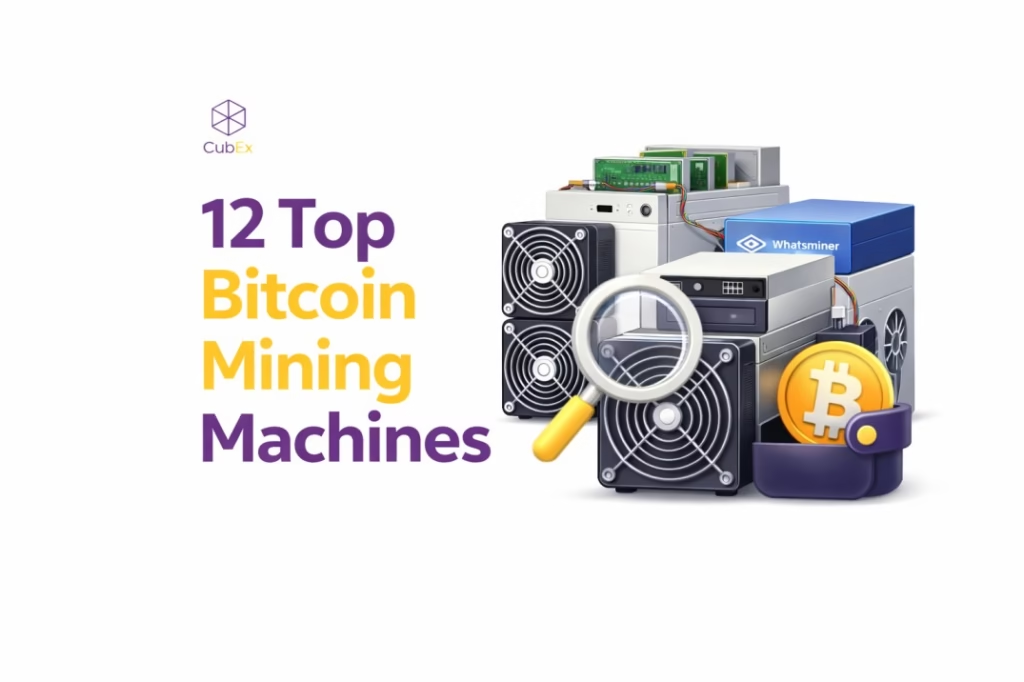
This post breaks down the top Bitcoin mining machines in 2026, what makes them different, and who they realistically work for.
Recommended Read:Top 10 Best Bitcoin Accelerators in 2025
Ways to Spot Fake USDT Transactions
What You’ll Learn in This Guide
- What Bitcoin mining machines actually do and why they matter
- If mining still makes sense today based on real conditions
- How to tell a solid machine from one that will drain your money
- Why electricity cost shapes your final earnings more than anything else
- A look at 12 mining machines that still hold relevance in 2026
What Is Bitcoin Mining and How Does It Work?
Bitcoin mining is the process of validating transactions and securing the Bitcoin network. Every time someone sends Bitcoin, that transaction needs to be checked, confirmed and recorded. Miners are the ones providing the computing power that makes this possible.
At the heart of mining is a simple idea: thousands of machines around the world are competing to solve a mathematical puzzle. The machine that solves it first earns the right to add a new block of transactions to the blockchain. As a reward, the miner receives newly created Bitcoin plus transaction fees from users.
To understand this better, it helps to break down what the machines are actually doing:
1. Each miner is running a specialised device built for speed
These machines are not regular computers. They are made to perform one task extremely well and process as many cryptographic calculations as possible in a very short time.
2. The machine keeps generating guesses
Mining is essentially billions of rapid calculations per second. Each calculation is a guess aimed at finding the right answer to a mathematical puzzle set by the network.
3. The machine with the highest output has a better chance of earning rewards
The more calculations a machine can perform per second, the more chances it has to find the correct solution before others.
4. When a machine finds the correct result, a new block is added
The winning miner broadcasts the solution to the network. Other miners verify it, and once it checks out, the block is added to the blockchain. The winner receives their reward.
5. This process repeats every ten minutes
The network is designed so a new block is produced roughly every ten minutes. As long as miners keep competing, the system continues smoothly.
Also Read:How To Trade Cryptocurrency Safely in Nigeria
Is Bitcoin Mining Profitable in 2026?
Mining gives mixed results. Some people earn well from it, while others struggle to cover their electricity bills. The difference usually comes down to a few things that influence how much you keep at the end of each month. Understanding these points helps you know what to expect.
1. The price of Bitcoin
When Bitcoin grows in value, the rewards you earn through mining become worth more. When the price falls, those rewards don’t go as far.
Miners deal with this constantly, so it’s important to keep this in mind before you start.
2. Mining difficulty
The Bitcoin network adjusts its difficulty every two weeks. If more miners join the network, it becomes harder to earn rewards but if many miners switch off their machines, the process becomes easier again.
This back-and-forth movement affects how much you can earn at any point in time.
3. Electricity cost
This is often the most important factor. Mining machines run day and night, and they consume a lot of power.
People in places with affordable electricity usually see better outcomes than those paying high rates.
Many beginners discover this only after they start, so it’s something worth checking early.
4. Machine efficiency
Mining machines don’t consume power at the same rate.
Some use far more electricity than they should for the amount of work they produce.
Others are set up to use less power while delivering stronger output.
Efficient machines help you save money over time, which can improve your earnings.
Mining can still work in 2026, but not for everyone. Some setups run comfortably and bring in good returns. Others struggle because the power cost is too high or the machine drains more electricity than it should.
The smartest approach is to understand the numbers before buying anything. Mining rewards people who make informed decisions, choose the right hardware and set up operations in a way that makes financial sense.
You may also like:10 Best Crypto Wallet Finder Tools- 2026
What Makes a Good Bitcoin Mining Machine?
1. High hash rate
More computational power means more chances to earn rewards.
2. Reasonable power consumption
Machines that use too much power without enough output will eat your profits.
3. Heat and noise control
ASICs are loud and generate a lot of heat. This affects where you can place them.
4. Durability
Some machines run for years without major issues. Others break down faster.
5. Availability of replacement parts
Fans, power supplies and control boards fail over time.Good machines have parts widely available.
Types of Bitcoin Mining Machines
ASIC Miners
ASICs are the main machines used for Bitcoin mining today. They are built for one job only, which makes them far more powerful than anything else you can buy. An ASIC focuses all its processing ability on mining and nothing else, which is why it produces strong results.
They offer high mining power, better energy use compared to other devices and longer usefulness over time
Anyone serious about mining today will eventually end up with an ASIC because the network is too competitive for general-purpose machines.
GPU Miners
GPUs were popular in Bitcoin’s early days. People used gaming graphics cards to mine at home because the network was small and easy to work with. That time is long gone.
Today, GPUs can’t keep up with the demands of Bitcoin mining. They don’t produce enough output to compete.This is why GPUs are now mostly used for other cryptocurrencies such as Ethereum Classic or certain altcoins.
Older or Outdated ASICs
There are many older ASIC models still being sold at discounted prices. They may look attractive, but most of them no longer hold up. They use too much electricity and deliver far too little mining power in return.
This combination makes them difficult to maintain and expensive to run. Beginners often buy them thinking they’re getting a bargain, only to realise the running cost is higher than the earnings.
Electricity Costs and Power Requirements You Should Know
Electricity plays a huge role in Bitcoin mining. It influences how much you spend each month and how much you keep as earnings. Many beginners focus on the price of the machine itself, but electricity is where most of the real cost sits.
Why electricity is so important
Mining machines run nonstop. They do not take breaks, they do not turn off at night and they do not slow down. Because they run all day, even a small change in your electricity price can make a big difference at the end of the month.
If your electricity cost is high, your mining rewards can get swallowed up by the bill.
If your cost is low or you have access to alternative power, mining becomes far more workable. It is the single biggest expense for anyone mining Bitcoin.
How much power mining machines use
Most modern ASIC miners use between 2500 and 3500 watts. To put that into everyday language, a single ASIC can use as much electricity as:
- a small freezer
- an air conditioner
- multiple home appliances running at once
Now think about that usage running twenty-four hours a day. That is why power planning is a key part of mining.
How to lower your electricity load
- Use off-peak hours where available because some regions charge less at night
- Keep the machine in a cool, open area so it does not overheat and waste extra power
- Consider solar panels or other alternative power sources if they are available and affordable
- Avoid running the machine in small, closed rooms that trap heat
- Check if your area offers different electricity plans
12 Best Bitcoin Mining Machines in 2026
1. Bitmain Antminer S21 Pro
Overview
One of the strongest ASICs in 2026, known for its balance of performance and efficiency.
Hash Rate & Performance
Around 250 TH/s.
Power Usage & Efficiency
Roughly 3500W with excellent efficiency for its output.
Estimated Profitability (2026)
Profitable in regions with lower electricity costs.
Best For
Beginners with stable power who want a long-term machine.
2. Bitmain Antminer S19 XP
Overview
A proven machine still widely used because of its reliability.
Hash Rate
140 TH/s.
Power Usage
3010W.
Profitability
Moderate but consistent in regions with fair electricity pricing.
Best For
Users who prefer a stable, well-known miner.
3. WhatsMiner M60
Overview
A 2026 update from MicroBT with impressive output.
Hash Rate
230 TH/s.
Power Usage
3420W.
Profitability
Strong in low-cost regions.
Best For
Users who want a balance of new technology and reliability.
4. WhatsMiner M50S+
Overview
Known for strong heat management and durability.
Hash Rate
144 TH/s.
Power Usage
3308W.
Profitability
Decent for beginners with good power access.
Best For
Home miners or small setups.
5. Bitmain Antminer S19 Pro Hyd
Overview
Uses hydro-cooling for better temperature control.
Hash Rate
177 TH/s.
Power Usage
5220W.
Profitability
Suitable for industrial or larger setups.
Best For
Miners with dedicated cooling.
6. Canaan AvalonMiner A1466
Overview
Canaan’s 2026 model built for durability.
Hash Rate
150 TH/s.
Power Usage
3300W.
Profitability
Moderate, depending on power rates.
Best For
Beginners who want a simple, long-lasting unit.
7. Bitmain Antminer T21
Overview
A budget-friendly version of the S21.
Hash Rate
190 TH/s.
Power Usage
3700W.
Profitability
Better suited for areas with lower electricity cost.
Best For
Entry-level miners.
8. Goldshell AL Box BTC Edition
Overview
A compact machine designed for smaller spaces.
Hash Rate
1.6 TH/s.
Power Usage
180W.
Profitability
Lower earnings but low power requirements.
Best For
Absolute beginners testing the waters.
9. iPollo B2
Overview
Simple and beginner-friendly.
Hash Rate
30 TH/s.
Power Usage
2400W.
Profitability
Limited unless electricity is cheap.
Best For
Low-budget miners.
10. Bitmain S17+ (Refurbished)
Overview
Older but still circulating in the market.
Hash Rate
73 TH/s.
Power Usage
2920W.
Profitability
Low, but possible with very affordable electricity.
Best For
Beginners who want a low-cost starter option.
11. WhatsMiner M30S++
Overview
Still widely used due to reliable performance.
Hash Rate
112 TH/s.
Power Usage
3472W.
Profitability
Moderate.
Best For
Small-scale miners.
12. Bitmain Antminer S19J Pro+
Overview
A refined version of the S19 series.
Hash Rate
122 TH/s.
Power Usage
3355W.
Profitability
Stable in countries with fair electricity.
Best For
Users upgrading from old models.
Cloud Mining vs Physical Mining Machines
What is Cloud Mining?
Cloud mining is a system where you rent mining power from a company instead of buying your own machine.You do not install anything at home,deal with heat, noise or electricity bills.
All you need to do is pay the company, and they use their machines to mine on your behalf. In return, you receive a portion of the Bitcoin the machines produce.
It sounds convenient, which is why beginners often look into it first.
Pros of Cloud Mining
- No hardware needed
You do not buy, store or maintain any machine. - No electricity costs
The company running the machines handles the power bills. - Easy for beginners
Since everything is already set up, you can start quickly.
Cons of Cloud Mining
- Many platforms are unreliable
Some do not pay users. Others disappear after collecting deposits. - Earnings are shared
You only get a portion of what the machine produces, not the full amount. - Contracts can lock you in
Some companies require long-term agreements that cannot be cancelled easily.
Because of these issues, a lot of people who try cloud mining end up disappointed. It is not always a scam, but it is very easy to choose the wrong company if you do not look closely.
Physical Mining Machines
This is the traditional way of mining. You buy your own ASIC machine, set it up and run it yourself.
This gives you:
- full control
- full rewards
- higher earnings if your electricity cost is low
But you also deal with:
- loud noise
- heat
- electricity bills
- maintenance
Can You Mine Bitcoin for Free Without a Machine?
You cannot mine real Bitcoin for free in any meaningful way. What people call free mining usually refers to faucet websites, small reward apps or platforms that give users tiny amounts of Bitcoin for completing tasks. These tools are good for learning how wallets and transactions work, but the payouts are extremely small. They cannot replace an actual mining machine, and they do not produce enough Bitcoin to count as real mining.
Are Free Bitcoin Mining Sites Legit?
Some free mining sites are legitimate, but many are not.
Because they promise rewards at no cost, they attract scammers and fake platforms.
Common warning signs include:
- Promises of guaranteed profits
- Lack of real withdrawal proofs
- No clear information about the company
- Requests for upfront payments or “unlock fees”
- Websites that disappear or reset balances suddenly
If a platform claims you can earn large amounts of Bitcoin for free, it is almost always unreliable.
Beginners should only test with very small amounts and avoid giving out personal details or payment information.
What Is the Best Bitcoin Mining Machine for Beginners?
For beginners, the best mining machine is one that is affordable, energy-efficient and easy to manage. A good beginner machine should offer:
- a moderate hash rate (not too high, not too low)
- reasonable power consumption to keep electricity bills under control
- manageable noise and heat
- the ability to run for long hours without frequent issues
Examples include:
- iPollo B2 — suitable for beginners who want to learn without spending too much.
- Refurbished Antminer S17+ — an affordable entry point for testing mining at home.
- Antminer S19 XP or WhatsMiner M50 series
How Much Does It Cost to Start Bitcoin Mining in 2026?
Costs include:
- Machine purchase
- Electricity
- Cooling
- Maintenance
- Mining pool fees
- Optional monitoring tools
conclusion
Bitcoin mining in 2026 is not easy money. It requires planning, understanding and the willingness to treat mining like a long-term project rather than a quick bet.
Mining can still make sense, but only when the conditions are right.
Electricity costs, machine efficiency and personal expectations play a major role.
If you learn before investing, approach mining with a clear mind and avoid hype, you’ll have a much smoother experience than most beginners.

Gideon
This is your bio
Best Apps to Withdraw Bitcoin to Naira