- Cryptocurrency
- By Gideon
In 2026, crypto operates in a regulatory limbo.
Across major economies, governments have moved from warnings and scattered enforcement to structured frameworks. Licensing regimes are clearer. Tax reporting is tighter. Stablecoin issuers face reserve scrutiny. Exchanges operate under defined compliance obligations.
At the same time, markets still react sharply to policy announcements. Prices can move within minutes of a regulatory headline. Liquidity can shift across jurisdictions overnight.
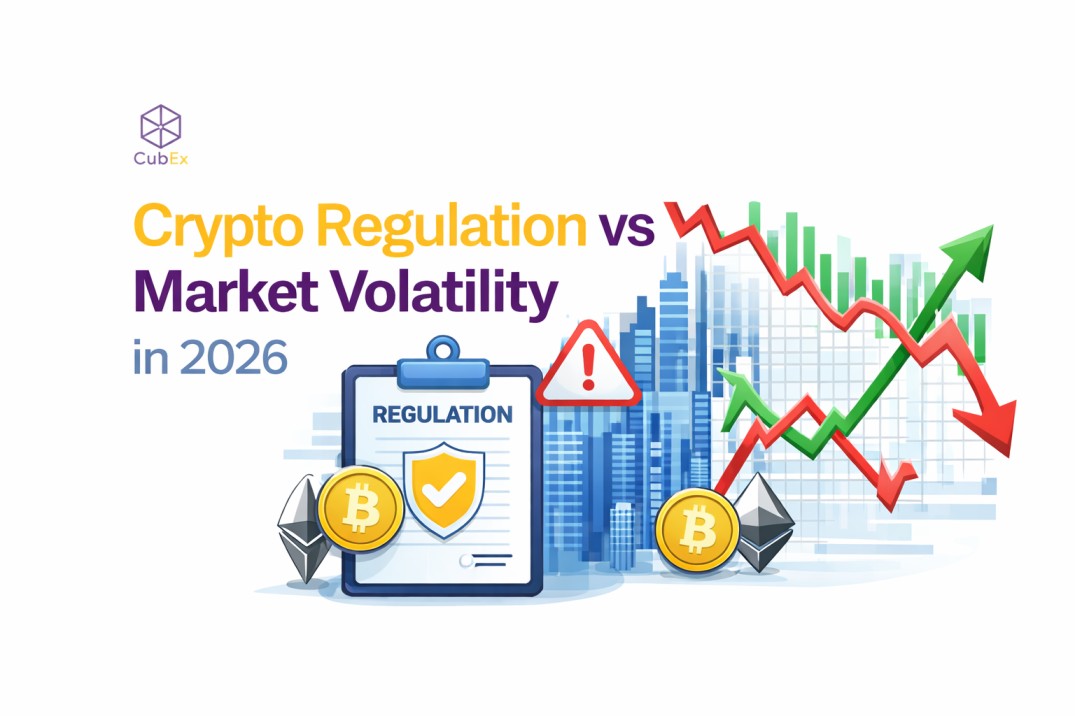
So the relationship between regulation and volatility is no longer theoretical. It is measurable.
This article examines how regulatory frameworks in 2026 are influencing crypto market behavior with particular attention to structural data, institutional participation, and emerging markets like Nigeria.
Related: Bitcoin Tax in Nigeria
Key Takeaways
- Crypto regulation in 2026 is structured, not reactive. Most major economies now operate with defined licensing, tax, and compliance frameworks rather than ad-hoc enforcement.
- Volatility has moderated compared to earlier cycles, but crypto remains more volatile than traditional asset classes.
- Regulation reduces systemic risk over the long term by improving exchange oversight, custody standards, and stablecoin transparency.
- Short-term volatility still spikes around regulatory announcements because markets reprice risk immediately often before full policy details are understood.
- Institutional participation is a stabilizing force. Deeper liquidity and longer investment horizons help compress extreme price swings.
- Retail-heavy markets like Nigeria may experience sharper short-term movements, especially during tax or compliance updates.
- AI-driven trading accelerates market reactions, causing faster volatility cycles but often quicker corrections as clarity emerges.
- Regulation does not eliminate volatility it reshapes it.
- Investors who track regulatory timelines and manage leverage carefully are better positioned during event-driven price swings.
What Is Crypto Regulation in 2026?
Crypto regulation refers to the legal and supervisory framework that governs how digital assets are issued, traded, taxed, and monitored within national financial systems.
Rather than debating if crypto should exist, governments are defining how it operates within existing economic structures.
In jurisdictions such as the United States and Nigeria, regulators now apply structured oversight through agencies like the U.S. Securities and Exchange Commission and the Securities and Exchange Commission Nigeria. Their frameworks typically address:
- Licensing requirements for exchanges
- Capital and custody standards
- Mandatory transaction reporting
- Asset classification guidelines
- Stablecoin reserve transparency
- Anti-money laundering compliance
Globally, regulatory coverage of crypto markets has increased significantly compared to five years ago. Industry policy trackers estimate that more than 80% of major economies now operate with formal or draft digital asset frameworks, a clear contrast to the fragmented environment of the early 2020s.
Financial markets behave differently when operating under defined rules. Clear standards influence participation, liquidity, and capital allocation decisions across the ecosystem.
What Does Market Volatility Represents in Crypto Markets?
Volatility refers to the degree and speed of price fluctuations within a defined period. In crypto markets, it is mostly measured using:
- 30-day or 90-day historical volatility
- Implied volatility in options markets
- Intraday price ranges
- Liquidation volumes in leveraged derivatives
Historically, Bitcoin’s annualized volatility often exceeded 80–100% during peak speculative cycles. By late 2025, 90-day volatility metrics for Bitcoin were closer to 35–40% still elevated compared to traditional equities, but materially lower than earlier phases of the market.
The compression did not occur in isolation. Several structural factors contributed:
- Broader institutional participation
- Increased exchange oversight
- Development of regulated custody solutions
- Expansion of derivatives markets
- Stablecoin transparency improvements
However, lower average volatility does not mean the absence of sharp movements. In 2026, volatility often appears concentrated around specific events, especially regulatory developments.
Why Regulatory Announcements Still Move Markets
Even in a more structured environment, change in policy usually influences pricing dynamics.
There are three main reasons:
1. Markets Price in Uncertainty Immediately
Financial markets are forward-looking. When regulators announce investigations, enforcement actions, or new compliance rules, traders reprice risk before full details are available.
This repricing can cause short-term price swings even when long-term fundamentals remain intact.
2. Liquidity Is Sensitive to Compliance Requirements
If a regulation alters how exchanges operate for example, by restricting certain trading pairs or leverage levels liquidity distribution can change quickly.
Liquidity shifts amplify price movements.
3. Algorithmic Trading Accelerates Reaction Time
AI-driven trading systems monitor regulatory news at once. Algorithms can respond within seconds of announcements, intensifying initial price moves.
This creates faster but often shorter volatility cycles compared to earlier years.
How Regulation Has Reduced Structural Risk
While short-term reactions remain visible, regulation has addressed some of the systemic vulnerabilities that once amplified volatility.
Exchange Oversight and Custody Standards
In earlier market cycles, exchange collapses triggered cascading sell-offs. In 2026, licensed exchanges must meet defined capital requirements and transparency standards in many jurisdictions.
This reduces counterparty risk that improves investor confidence particularly among institutions.
Stablecoin Transparency
Stablecoins underpin a significant share of crypto trading volume. In 2026, reserve disclosures and third-party attestations are increasingly required in regulated markets.
Greater transparency reduces fears of sudden liquidity breakdowns, which previously caused panic selling.
Institutional Capital Participation
Institutional allocation to digital assets has increased steadily since 2023. Surveys from asset management firms suggest that a majority of institutional investors now maintain some exposure to digital assets, even if modest.
Institutional capital tends to be less reactive than retail-driven momentum. It deepens order books and reduces extreme price gaps. Over time, this contributes to volatility compression.
The Nigerian Perspective: Retail Adoption in a Structured Environment
Nigeria remains one of the highest crypto adoption markets globally. Peer-to-peer trading volumes have historically ranked among the highest worldwide.
As regulatory clarity improves under the supervision of the Securities and Exchange Commission Nigeria, traders are facing:
- More defined tax obligations
- Stronger reporting requirements
- Increased scrutiny of exchange operations
In retail-heavy markets, volatility can remain pronounced because participation is largely driven by individual traders rather than institutional flows.
However, clearer tax and compliance rules reduce long-term uncertainty. When investors understand reporting requirements in advance, they are less likely to react impulsively to speculation about potential bans or sudden restrictions.
For platforms operating within compliance frameworks, regulatory clarity can improve user trust over time.
Related:Best Binance Alternatives to Sell Bitcoin
Does Regulation Compress Volatility Over the Long Term?
When we talk about volatility compression, we mean a reduction in extreme, unpredictable price swings over longer periods.
There is empirical evidence and market data showing that regulated environments and transparent policies are associated with calmer price behavior over time, even though short-term movements still occur.
- Decline in Measured Volatility Over Recent Years
Recent market measures show that Bitcoin’s long-term volatility has trended lower compared with earlier cycles with realized 30-day and 90-day volatility significantly reduced from peaks seen in prior years. For example, Bitcoin’s 30-day realized volatility averaged around mid-50% in 2025, compared with more than 120% during the 2021 peak and even higher earlier in the decade illustrating how volatility metrics can moderate as markets mature and become more structured. - Regulatory Compliance and Volatility Metrics
Industry data indicates that assets and markets with stronger compliance measures often show lower volatility compared with weakly regulated environments. In one dataset, assets traded on compliant platforms displayed around 31.4% volatility compared with 73.8% on weaker compliance platforms over the same period suggesting that regulatory clarity can correspond with tighter trading ranges. - Institutional Participation Trends
Regulatory frameworks that improve legal clarity tend to increase institutional engagement. According to multiple policy trackers, institutional digital-asset initiatives expanded in over 80% of jurisdictions, and around 55% of hedge funds reported digital asset exposure, up from the prior year, indicating more stable capital is entering the market.
How Regulation Affects Volatility
Based on research and real-world observations, here’s how regulation influences price behavior over time:
- Structured frameworks reduce risk perception: Defined rules for reporting, licensing, and custody make markets appear safer to larger, long-term investors.
- Liquidity improves: As compliant exchanges attract more participants and capital, depth increases, which can reduce extreme price jumps.
- Volatility becomes event-driven rather than panic-driven: Instead of sharp crashes tied to fear of outright bans, volatility tends to occur around policy events and macro announcements meaning markets react in anticipation rather than panic.
- Regulation influences where and how capital flows: Coordinated frameworks can reduce regulatory arbitrage where capital jumps between jurisdictions based on rule uncertainty, which in earlier years amplified swings.
What This Means in 2026
Volatility in 2026 looks different from earlier cycles:
- It clusters around macroeconomic and regulatory announcements.
- It resolves faster once details become clear.
- It is less frequently driven by fear of outright prohibition.
Regulation does not remove price movement. It changes the structure of how and when markets react.
Where Regulation Can Still Increase Volatility
Regulation does not operate in a vacuum. There are circumstances where it can amplify short-term instability.
Ambiguous Policy Communication
When regulators issue guidance without implementation details, markets interpret unpredictability as risk. Ambiguity increases price swings.
Sudden Enforcement Actions
If authorities announce unexpected investigations into major market participants, liquidity may temporarily retreat.
Tax-Driven Selling Pressure
Defined tax reporting cycles can encourage short-term asset sales before deadlines, creating concentrated selling periods.
These effects are typically shorter-lived than earlier regulatory shocks, but they remain relevant in 2026.
Related:A Complete Guide to Crypto Network Fees
Comparing Regions: Regulatory Clarity and Volatility Patterns
Different regions exhibit distinct relationships between regulation and volatility.
Region | Regulatory Structure | Institutional Presence | Volatility Pattern |
United States | Advanced asset classification and licensing frameworks | High institutional allocation | Moderate volatility, event-driven spikes |
Nigeria | Evolving compliance and tax clarity | Retail-dominant participation | Higher short-term volatility |
Europe | Comprehensive digital asset frameworks | Growing institutional access | Gradual volatility compression |
The Role of Institutional Adoption in 2026
Institutional adoption has shifted the structure of crypto markets.
Asset managers, hedge funds, and family offices typically operate with:
- Risk management frameworks
- Diversified portfolios
- Longer investment horizons
- Compliance departments
Their participation introduces stability in several ways:
- Larger and deeper order books
- Reduced reliance on leverage-driven retail flows
- More measured responses to news
However, institutions do not eliminate volatility. They respond to macroeconomic and regulatory developments as well. The difference lies in pace and scale.
The Influence of Artificial Intelligence on Market Reactions
By 2026, AI-driven analysis tools are integrated into many trading systems.
Automated sentiment monitoring scans regulatory filings, press releases, and policy updates. Natural language processing tools interpret tone and risk implications almost instantly.
This has two effects:
- Market reactions occur faster.
- Corrections may also happen more quickly once clarity emerges.
While AI accelerates volatility cycles, it may reduce prolonged mispricing because information spreads rapidly.
Is Crypto Becoming More Stable or Structured?
The evidence suggests that crypto in 2026 is becoming more structured rather than fully stable.
Average volatility metrics have moderated compared to earlier cycles. Institutional capital has increased. Compliance standards are clearer.
Yet, crypto remains a growth-oriented, globally interconnected asset class. Price movement is inherent.
Regulation has not removed volatility. It has changed its character.
Volatility is now more closely tied to policy shifts, macroeconomic conditions, and liquidity transitions rather than existential uncertainty about legality.
Final Reflection
The relationship between crypto regulation and market volatility in 2026 is not adversarial.
Regulation reduces systemic risk and improves transparency. It encourages institutional participation and strengthens market infrastructure.
At the same time, policy updates introduce moments of repricing. Markets adjust quickly to new information, especially in an era of AI-driven trading.
For investors, the goal is not to avoid volatility entirely. It is to understand its sources.
In 2026, volatility is less about fear of prohibition and more about adaptation to structured oversight. That distinction defines the current era of digital asset markets.
Frequently Asked Questions
Does crypto regulation reduce market volatility?
Yes, over the long term it can reduce extreme price swings. Defined legal frameworks increase institutional participation, deepen liquidity, and lower the risk of large-scale exchange failures. However, announcements from regulators can still trigger short-term price spikes.
Why do regulatory announcements cause price drops?
Because traders reprice risk immediately. When a government agency announces investigations, enforcement actions, or new compliance requirements, investors often sell before fully assessing the details.
Is crypto more stable in 2026 than before?
Compared to earlier cycles, volatility levels for major assets like Bitcoin are lower on average. However, crypto remains more volatile than traditional equity or bond markets. It is less chaotic than previous cycles, but still highly responsive to news and liquidity flows.
How does regulation affect Nigerian crypto traders?
In Nigeria, digital asset oversight influences taxation, exchange licensing, reporting obligations, and banking access. Traders must account for tax liabilities and platform requirements. These obligations can affect timing decisions, especially near reporting periods.

how-to-swap-crypto-instantly-in-nigeria